Crown Street, Wollongong, 2500

Does Claude Watermark AI Writing? What It Means for Blogs, Google and ChatGPT
Melody Jaimon • September 18, 2026
If you've seen posts claiming that Claude is now secretly watermarking everything it writes, you're not imagining the conversation.
Anthropic, the company behind Claude, announced in August 2026 that it was introducing text watermarking into Claude-generated content.
And naturally, people started asking questions.
Can someone tell I used Claude?
Will Google know my blog was written with AI?
Could AI-watermarked content hurt my Google rankings?
What happens if I write something myself and only ask Claude to improve it?
Does the watermark identify me or my business?
Is ChatGPT doing the same thing?
For businesses using AI in marketing and content creation, these questions are much more useful than simply asking whether Claude has a watermark.
At Love My Online Marketing, we use AI tools in our own workflow, so we've taken a closer look at what Anthropic has actually announced, what the watermark can and can't tell someone, what Google says about AI-assisted content, and what businesses should realistically do about it.
The short version?
Don't panic and don't stop using AI just because you've heard the word "watermark".
But it is worth understanding what has changed.
Yes, Claude Is Introducing Watermarks Into AI-Generated Text
Anthropic has announced a system for watermarking text produced by supported Claude models.
But when people hear "watermark", they often imagine something hidden inside a document.
Perhaps a secret code.
Invisible characters.
Metadata attached to a Word document.
Your account details are hidden somewhere in the file
That's not how Anthropic describes its text watermark.
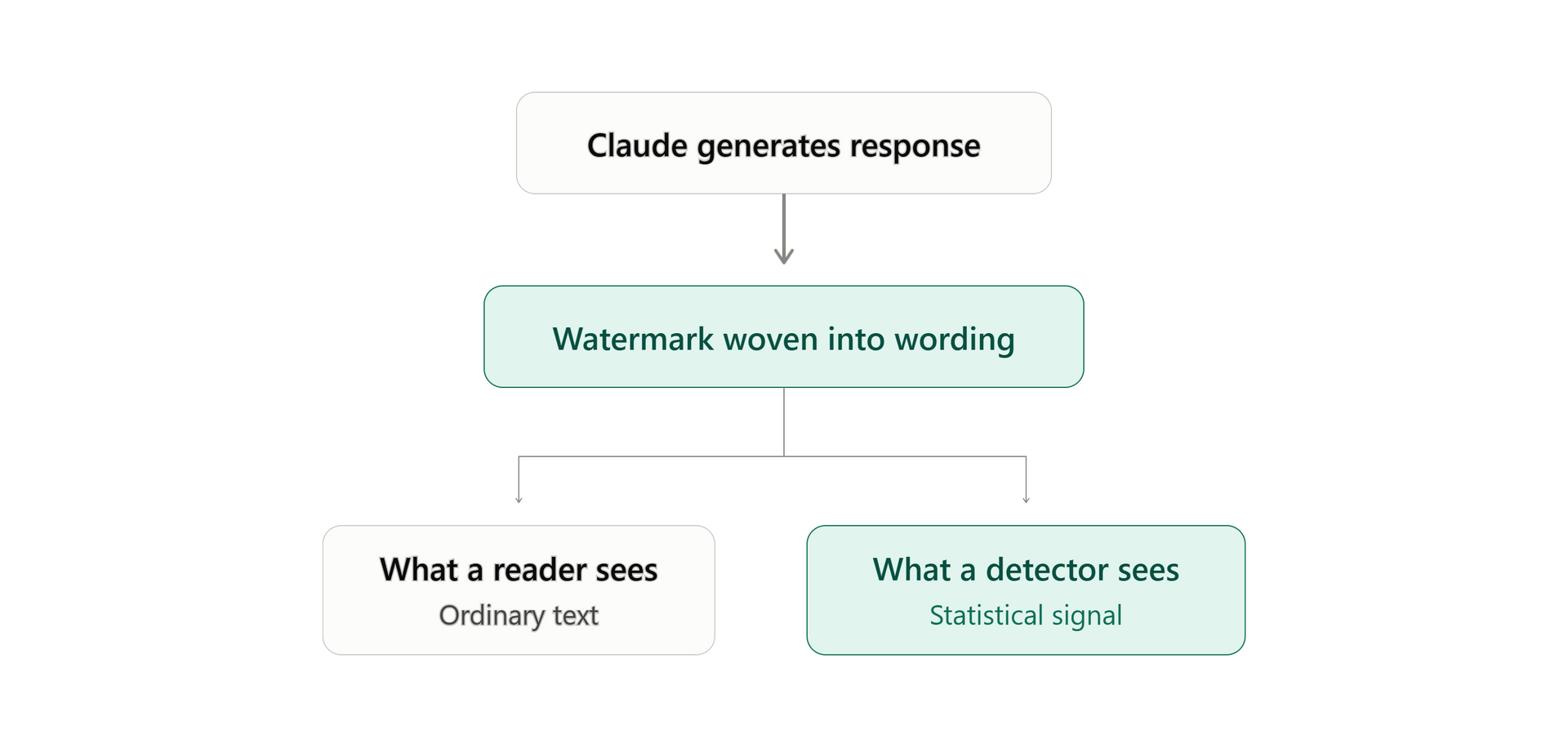
Instead, the watermark is built into how the model generates language.
Claude makes subtle choices between possible words as it generates a response. Anthropic's watermarking system influences some of those choices in a way that creates a statistical pattern.
To a person reading the article, it should still look like ordinary writing.
But with the appropriate detection system, that statistical pattern can potentially be identified.
So it's less like a tracking number secretly attached to your document and more like a statistical fingerprint within the generated language.
That's an important distinction.
So What's the Point of the Watermark?
This was one of our first questions too.
If the watermark doesn't tell someone who used Claude, what's it actually for?
The purpose is essentially content provenance and transparency.
The watermark can provide evidence that a supported Claude model helped generate or transform a piece of text.
It is not designed to identify the individual behind that text.
According to Anthropic, its text watermark doesn't contain identifying information about the user, their organisation or the conversation that produced the content.
In simple terms, an appropriate detector may potentially help answer:
"Does this text contain the statistical watermark associated with Claude?"
It isn't designed to answer:
"Who generated this?"
"Which Claude account did it come from?"
"Which business created it?"
"What prompt did they use?"
"What was said in their Claude conversation?"
That distinction gets lost very quickly when the story is reduced to:
"Claude is secretly tagging your writing."
That makes it sound as though Anthropic is embedding your identity into everything you generate.
That isn't what Anthropic says its watermark does.
Why Is Anthropic Doing This?
The change is connected to Europe's evolving rules around AI-generated content.
Article 50 of the European Union's AI Act contains transparency obligations concerning certain AI-generated and AI-manipulated content.
The EU also has a Code of Practice on Transparency of AI-Generated Content, designed to help providers meet relevant transparency requirements.
Anthropic is one of the companies participating in this broader transparency framework.
The important point is that this isn't happening in isolation.
Governments, AI companies, researchers and other organisations are grappling with a much bigger question:
As AI-generated material becomes increasingly difficult to distinguish from human-created material, how can its origins be made more transparent?
Text watermarking is one technical approach to that problem.
Is Claude's Watermark Hidden Metadata?
No, not according to Anthropic's description of its system.
This matters because metadata is relatively easy to understand.
Take a photograph, and it might contain information about the camera.
Create a document, and the file might contain information about the software used to produce it.
Copy the contents into another format, and that metadata may disappear.
Claude's text watermark works differently.
The model creates the signal through its choices while generating the text.
That means simply copying and pasting the words doesn't necessarily remove it.
The words are where the statistical pattern exists.
Does the Claude Watermark Identify You or Your Business?
According to Anthropic, no.
This is probably one of the most reassuring facts for businesses concerned about the announcement.
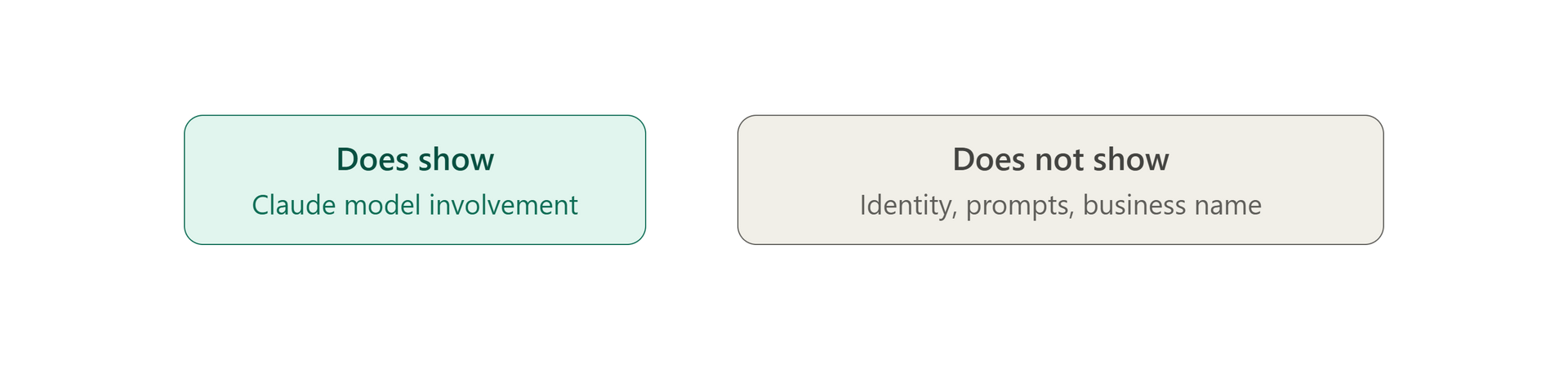
Anthropic says the watermark does not encode identifying information about the person using Claude, their organisation or their conversation.
So if Love My Online Marketing used Claude to help edit an article, the watermark isn't supposed to contain a hidden message saying:
"This was generated by Love My Online Marketing."
It isn't designed to reveal our Claude account.
It doesn't contain our original prompt.
And it isn't supposed to provide access to the conversation that produced the text.
The watermark concerns the AI model's involvement, not the identity of the person using it.
Can Anyone Detect Claude's Watermark?
This is another area where online discussion can create the wrong impression.
Anthropic's detection capability isn't a public website where anyone can paste your article and immediately receive definitive proof that you used Claude.
Detection access has been limited while the technology is being introduced and evaluated.
That distinction matters.
The existence of a watermark does not automatically mean every client, employer, teacher, competitor or random person on the internet has a magic button that can reliably determine how your content was created.
And even where watermark detection is available, interpreting the result correctly matters enormously.
Why?
Because Claude touching a piece of writing isn't necessarily the same thing as Claude authoring the ideas within it.
What If I Write Something Myself and Ask Claude to Improve It?
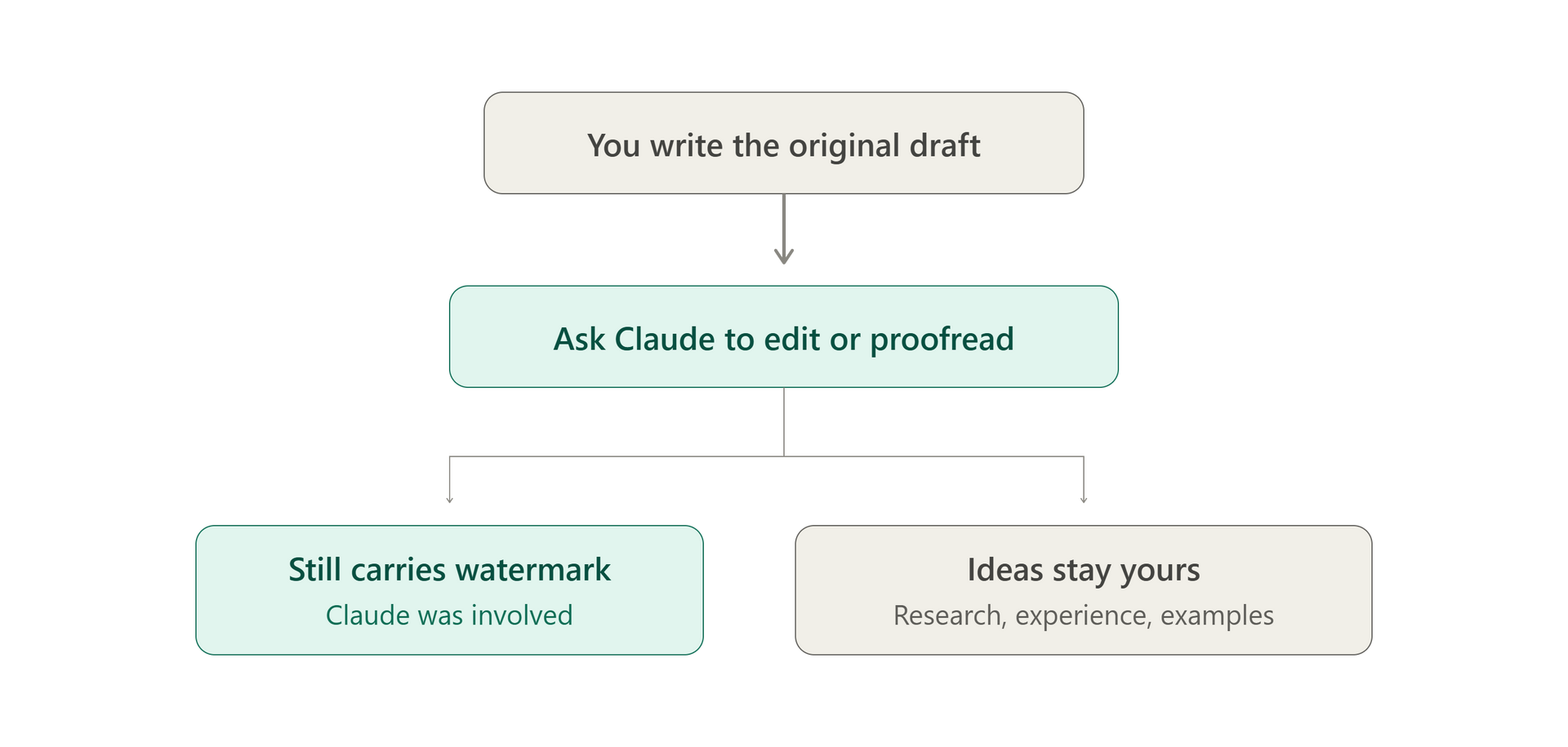
This is where things become genuinely interesting.
Imagine you sit down and write a 2,000-word article yourself.
The ideas are yours.
The experience is yours.
The examples are yours.
The research is yours.
You write every paragraph.
Then you give the article to Claude and say:
"Please correct the spelling, improve the grammar and make this easier to read."
Claude processes and rewrites portions of your text.
The resulting output may contain Claude's watermark.
Does that mean Claude wrote the article?
No.
Does it mean Claude had the experiences described in it?
Obviously not.
Does it mean Claude conducted all of the research?
Not necessarily.
It means a watermarked Claude model was involved in processing the text.
That's an extremely important distinction, particularly in areas such as education, publishing, professional services and intellectual property.
Detection of AI involvement isn't necessarily proof of AI authorship.
Can Claude's Watermark Disappear?
Potentially.
Anthropic acknowledges that text watermarking isn't indestructible.
Substantial rewriting, editing, paraphrasing, translation and combining AI-generated text with other writing can weaken the detectable signal.
That creates another important limitation.
If a watermark is detected, that doesn't necessarily tell you how much intellectual contribution came from AI.
And if a watermark isn't detected, that doesn't necessarily prove that AI wasn't involved.
Watermark detection therefore shouldn't be treated as a magical AI lie detector.
It is a technical signal that needs to be interpreted in context.
What Happens If I Use Claude to Write Blogs for My Website?
Now we get to the question most business owners probably care about.
If I use Claude to help write blogs for my website, is this watermark going to hurt my Google rankings?
Based on Google's published guidance, there is no reason to conclude that the existence of a Claude watermark by itself should hurt your SEO.
Google does not prohibit content simply because generative AI was involved in creating it.

Google's focus is much more heavily centred on the quality, usefulness and purpose of the content.
That means using Claude to help:
- research a subject
- brainstorm ideas
- structure an article
- create a first draft
- improve readability
- rewrite awkward sections
- correct grammar
- translate content
- summarise research
- develop FAQs
isn't automatically an SEO problem.
The much bigger issue is
what you ultimately publish.
AI Content Isn't Automatically Bad SEO
There is an enormous difference between using AI as a tool and using AI to manufacture enormous amounts of low-value content.
Imagine two businesses.
One tells an AI:
"Write 500 articles targeting every suburb in Australia so we can rank for as many keywords as possible."
The pages contain essentially the same generic information with locations and keywords changed.
The other business uses AI to help turn genuine experience into a detailed article answering a question customers regularly ask.
The business adds:
- its own experience
- genuine examples
- original photographs
- expert observations
- useful recommendations
- fact-checking
- current information
- human editing
AI may have been involved in both processes.
But the finished products are fundamentally different.
This isn't just an SEO-versus-AI question, it's the same shift we cover in our guide to Answer Engine Optimisation (AEO): visibility now depends on being the answer worth surfacing, not just a page that technically ranks.
Google's spam policies focus on practices such as scaled content abuse, where large amounts of content are created primarily to manipulate search rankings rather than genuinely help users.
So asking:
"Did AI write this?"
is often less useful than asking:
"Why does this page deserve to exist?"
Can Google Detect Claude's Watermark?
This is where it's important not to turn speculation into fact.
Anthropic has developed a way to detect its watermark.
That doesn't mean we should automatically assume Google Search is using Claude's watermark as a ranking signal.
We have not seen Google announce that pages containing Anthropic's Claude watermark will be demoted in search results.
Google's published guidance continues to focus on content quality and compliance with its spam policies rather than imposing a blanket prohibition on AI-assisted writing.
Could Google have sophisticated systems for analysing content?
Of course.
But that's very different from claiming:
"Google detects Claude watermarks and penalises your website."
We don't have evidence to support that statement.
So businesses shouldn't build their content strategy around trying to "hide" AI from Google.
Build it around creating something worth finding.
Does Google Penalise AI-Generated Content?

Not simply because AI was used.
Google has repeatedly focused on the purpose and quality of content rather than saying that AI-generated content is automatically unacceptable.
Where businesses can get into trouble is using AI or other automation to generate large amounts of low-value content primarily for manipulating search results.
This is also why blindly publishing whatever ChatGPT or Claude gives you is a poor SEO strategy.
AI can generate perfectly readable content that adds almost nothing new.
And the internet doesn't desperately need another generic 1,500-word article repeating the same ten points already covered by 500 other websites.
For businesses trying to build long-term organic visibility, your competitive advantage is often the information an AI model doesn't already have.
Your experience.
Your customers' questions.
Your projects.
Your photographs.
Your data.
Your processes.
Your successes.
Your mistakes.
Your local knowledge.
Your professional judgement.
Your actual opinion.
Those are the things that can turn an AI-assisted article into genuinely useful business content.
Should I Edit AI-Generated Blogs Before Publishing Them?
Absolutely.
But not because you need to desperately scrub out some invisible Claude watermark.
Edit them because AI can be wrong.
AI can misunderstand context.
It can confidently present inaccurate information.
It can invent details.
It can use bland language.
It can repeat itself.
It can sound like every other AI-assisted article on the internet.
And it doesn't automatically know what makes your business different.
Human review is therefore an important part of a sensible AI content workflow.
At Love My Online Marketing, we don't think the goal should be to make content "undetectably AI."
The goal should be to make it genuinely good.
What About ChatGPT? Does ChatGPT Watermark Its Writing?
This is probably the next obvious question.
If Anthropic is watermarking Claude-generated text, what is happening with ChatGPT?
As of September 2026, OpenAI does not say that ordinary text generated by ChatGPT carries an invisible text watermark comparable to the system Anthropic has announced for Claude. OpenAI's current provenance system covers supported images (through C2PA Content Credentials and SynthID) and is being expanded to audio. In its own July 2026 statement on EU AI Act compliance, OpenAI says it is "working to expand provenance measures for OpenAI's systems across modalities, including text, as standards and tooling continue to mature," but that hasn't shipped yet.
Worth knowing why it's taken longer: OpenAI actually built a working text-watermarking method back in 2024 and chose not to release it. In OpenAI's own update on the research, the company said the method was "highly accurate and even effective against localized tampering, such as paraphrasing," but "less robust against globalized tampering," such as translation or rewording with another AI model. OpenAI also stated that the method "has the potential to disproportionately impact some groups," for example, that it "could stigmatize use of AI as a useful writing tool for non-native English speakers." So this isn't a case of OpenAI not having the technology, it's a case of the company deciding the risks weren't worth it yet.
So be wary of claims like:
"All AI writing now contains a secret watermark."
That's not accurate, at least not yet, and not for every provider.
What Anthropic has publicly described for Claude should not automatically be attributed to ChatGPT or another AI model.
And this is an area we'll be watching closely. As OpenAI expands its provenance work into text, we'll update this article.
Will Using ChatGPT or Claude Hurt My SEO?

The tool itself isn't the most useful way to think about the question.
You could create an excellent article with Claude.
You could create an excellent article with ChatGPT.
You could also create terrible content with either.
And, importantly, a human can write terrible SEO content without using AI at all.
The tool doesn't determine the usefulness of the finished page.
Your process does.
For business content, we'd rather see AI used to help create one genuinely useful article than generate 50 forgettable ones.
A Better Way for Businesses to Use AI for Content
Our preferred approach looks something like this.
Start with a real customer question.
Work out what someone searching that question actually needs to know.
Bring in your business's genuine expertise and experience.
Use AI where it helps with research, organisation, drafting or editing.
Check factual claims against reliable sources.
Add examples that could only come from your experience.
Remove generic filler.
Make sure the finished article sounds like your business rather than a generic AI assistant.
Then have a human read the entire thing before publishing it.
That's a far more sustainable strategy than worrying about whether changing three words will fool an AI detector.
Should You Stop Using Claude Because of Watermarking?
For ordinary business content creation, we don't see the watermark announcement alone as a reason to stop using Claude.
It does, however, give businesses another reason to think carefully about how they're using AI.
There may be industries, contracts, educational environments or professional situations where AI use needs to be disclosed or where particular rules apply.
Those requirements should obviously be respected.
But for a business using AI appropriately to help create website copy, social media content, marketing ideas or blog articles, the existence of a watermark doesn't suddenly make those uses illegitimate.
The question is still:
Are you comfortable standing behind what you've published?
If your company name is on an article, somebody in your business should be prepared to take responsibility for its accuracy and usefulness.
That's true whether the first draft came from Claude, ChatGPT, an employee, a freelancer or your marketing agency.
Why Are Some Claude Users Unhappy About This?
There is a legitimate concern underneath some of the online backlash.
People don't all use AI in the same way.
One person might ask Claude:
"Write my entire assignment for me."
Another might spend five hours writing an assignment themselves and then ask:
"Can you fix my grammar?"
If both resulting documents contain evidence of Claude's involvement, the watermark alone doesn't explain the difference between those two situations.
That's particularly important in areas where accusations of undisclosed AI use could have serious consequences.
A watermark may indicate AI involvement.
It does not automatically establish the extent or nature of that involvement.
That's why organisations using AI detection systems need to understand their limitations rather than treating a detection result as conclusive evidence about authorship.
Can You Remove Claude's AI Watermark?

Technically, substantial transformation of text may weaken a statistical watermark.
But for businesses, we think focusing on removing the watermark is asking the wrong question.
If you're rewriting content purely to defeat detection, you're spending your time solving a problem that may have little relationship to whether the content is actually any good.
Instead, spend that time improving the article.
Add your own examples.
Check the claims.
Interview someone in the business.
Include photographs.
Add data.
Explain what you've learned from working with customers.
Update outdated information.
Remove unnecessary waffle.
Make the content yours because you've contributed something worthwhile, not because you've tried to trick a detection system.
Does AI-Written Content Need to Be Disclosed?
This is going to depend heavily on context.
A school or university may have specific rules.
A client contract might have AI provisions.
Certain regulated or professional environments may have their own requirements.
Platforms and jurisdictions may also introduce specific disclosure obligations.
So there isn't one universal answer that applies to every use of AI-generated text.
For ordinary business marketing, it's sensible to have an internal policy about how AI is used and who takes responsibility for what gets published.
Transparency doesn't necessarily require putting a giant "WRITTEN BY AI" banner above every blog that used an AI-assisted grammar check.
But businesses should understand where AI is being used and ensure that their practices comply with any applicable legal, contractual, industry or platform requirements.
Claude Watermark FAQs
We've structured these using the same approach covered in our guide to
using FAQs to improve SEO and AEO visibility, clear questions, direct answers, no filler.
Our Take at Love My Online Marketing
At Love My Online Marketing, a Wollongong web design and digital marketing agency, we use AI tools.
We're not embarrassed about that, and we're not going to pretend otherwise.
AI can be incredibly useful for research, brainstorming, organising information, challenging ideas, improving drafts and finding questions we might otherwise have overlooked.
But we don't believe pressing a button and publishing whatever comes back is a content strategy.
The value still comes from knowing the business.
Knowing its customers.
Understanding what people are actually searching for.
Checking the facts.
Adding genuine experience.
Making decisions about what belongs in the article and what doesn't.
And having a human willing to put their name behind the finished result.
That's why Claude's watermark doesn't particularly change our approach.
If anything, the conversation around watermarking highlights something we've believed for a long time:
Businesses shouldn't be trying to create content that looks like it wasn't made with AI.
They should be trying to create content that's genuinely worth reading.
If AI helps you do that more efficiently, great.
If AI is being used to pump thousands of generic words onto a website purely because somebody thinks more pages automatically equals better SEO, you've probably got a bigger problem than an invisible watermark.
The Bottom Line
Claude's new text watermark sounds much scarier when it's described as a "secret AI tracking system" than when you look at what Anthropic says it actually does.
It doesn't secretly insert your name into your blog.
It doesn't tell someone which business generated the content.
It doesn't reveal your prompt.
It doesn't provide access to your Claude conversation.
And we haven't seen evidence that Google penalises websites simply because Claude's watermark is present.
It is a technical mechanism intended to help identify text generated or transformed by supported Claude models.
For businesses using AI for content and SEO, our advice is simple:
- Don't obsess over hiding the AI.
- Obsess over making the content useful.
- Bring your own expertise.
- Add something original.
- Check your facts.
- Edit properly.
- Know why the page exists.
And make sure that when somebody finds it through Google, it actually answers the question that brought them there.
That's a much better long-term content strategy than trying to outsmart an AI detector.
Sources and Further Reading
- How Claude marks AI-generated content — Anthropic's official explainer
- Code of Practice on Transparency of AI-Generated Content — European Commission
- Google Search's guidance about AI-generated content — Google Search Central
- Spam policies for Google web search — Google Search Central, scaled content abuse
- Advancing responsible AI across Europe — OpenAI's July 2026 statement
- Understanding the source of what we see and hear online — OpenAI's 2024 research on text provenance and watermarking
As this technology and the regulations around it continue to develop, we'll update this article when there are meaningful changes.


Love My Online Marketing has 10+ Years of working alongside businesses and helping them grow. Discuss your options for online success from website Design and Development through to Google Marketing.
Do you want more traffic and business leads?
Love My Online Marketing is determined to make a business grow. Our only question is, will it be yours?